Emmanuelle Saada, in conversation with Youssef Ben Ismail, Kavita Sivaramakrishnan, and Gregory Mann, moderated by Madeleine Dobie
New Books in the Arts and Sciences series
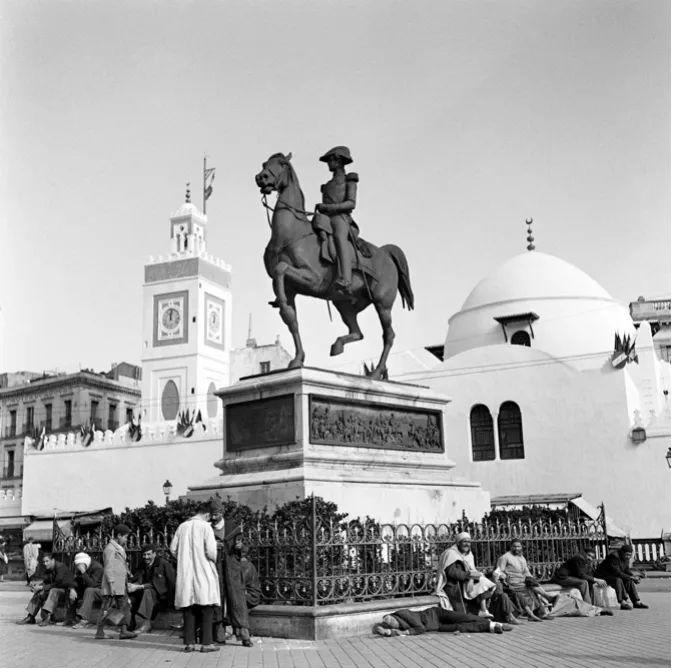
Colonial legacies dominate many contemporary political debates around the world. How do historians contribute to these debates and to the understanding of colonial situations, past and present? Starting with the observation that modern history is, in part, a product of colonial projects, Emmanuelle Saada’s new book, Histoires et colonisations: Des récits de la conquête aux héritages post-coloniaux (Gallimard, 2026) revisits major historiographical debates and controversies of the past two hundred years by testing them against a wide range of colonial situations, spanning five continents and five centuries. She explores how historians have forged their concept of colonization from very diverse historical situations, including the U.S., Israel, and Ireland. Her book shows how engagement with colonial contexts has transformed historians' methods and writing practices.
Histoires et colonisations: Des récits de la conquête aux héritages post-coloniaux has been reviewed in Le Monde and Liberation and is the subject of podcast episodes on Paroles d’histoire and Chemins d’histoire.
This event is presented as part of the New Books in the Arts and Sciences series, with support from the Dean of Humanities and The Society of Fellows and Heyman Center for the Humanities, Department of French, Maison Française, and Department of History.
Biographies
Emmanuelle Saada teaches French and History at Columbia University. Her main field of research is the history of French imperialism in the 19th and 20th centuries, with a specific interest in law, race, and immigration. Her first book Empire's Children: Race, Filiation and Citizenship in the French Colonies was translated into English by the University of Chicago Press in 2012 and her new book, Histoires et Colonisations: Des récits de la conquête aux héritages postcoloniaux, was published by Gallimard in 2026. She is currently working on a project on law and violence in Algeria and France in the nineteenth century.
Youssef Ben Ismail is a historian of law and empire in the Middle East and North Africa. His research deals with the history of international law, French imperialism, and Ottoman-Arab political thought. He is currently an Assistant Professor of Law, Jurisprudence, and Social Thought at Amherst College. Prior to that, from 2021 to 2024, he was a Postdoctoral Fellow in the Society of Fellows for the Humanities at Columbia University. His recent publications include a research article titled “Ce que protéger veut dire: la juridiction consulaire à l’âge des protectorats," published in Annales: Histoire et Sciences Sociales (2026/2); a special issue of the Journal of the Ottoman and Turkish Studies Association co-edited with Jessica Marglin and titled “Towards a Maghribi Turn in Ottoman History;” and a chapter on manuscript theft in colonial Algeria for the edited volume Colonisations: Notre Histoire (Seuil). In addition to his scholarly work, he occasionally writes review essays for the London Review of Books.
Kavita Sivaramakrishnan is Ronald H. Lauterstein Associate Professor of Sociomedical Sciences at Columbia University. She is a public health historian of South Asia with a focus on the politics of health, medicine and science in the global South. Her early research focused on the politics of ‘indigenous’ Ayurvedic medicine and its reconfiguring in a late colonial context in North India through claims and representations based on language and religion. She has also worked on social histories of epidemics and the role played by experts and scientific evidence, including the plague and its national and regional politics in South Asia. In 2018, she published As the World Ages: Rethinking a Demographic Crisis (Harvard University Press). She has completed a co-authored book manuscript on the politics of medicine and development, and heart disease in India to be published by Cambridge University Press in 2027. Kavita is co-editing a book on the cultural history of 20th century epidemics, and she is currently engaged in a new book project on the history of the chronic in South Asia.
Gregory Mann is a professor in the History Department at Columbia University. He is the co-founder, with Emmanuelle Saada, of the Beyond France University Seminar. His most recent book, Africa and France: a History, is currently in press with Cambridge.
Madeleine Dobie teaches French and Comparative Literature at Columbia University. Her research and teaching focus on francophone colonial and postcolonial culture. Her publications include: Foreign Bodies. Gender, Language & Culture in French Orientalism (Stanford, 2001, 2003), Trading Places. Colonization & Slavery in Eighteenth-Century French Culture (Cornell, 2010) and Mayotte Capécia ; une femme des Antilles dans l’espace colonial français (co-written with Myriam Cottias) (2012). She has also coedited A Comparative Literary History of Slavery, Vol. 1 (2024) and journal issues on Maryse Condé and Assia Djebar. She has recently co-edited with Olivia Harrison an issue of Esprit créateur devoted to Faits divers and the Fictions of Race and she is writing a book about belated testimonies of the Algerian War.
Event Details & Important Information
Seating is first come, first served. We recommend arriving early. Registration does not guarantee a seat.
Important: Campus Access Requirements
Columbia’s campus is currently open only to Columbia-affiliated guests (with a valid CUID).
If you do not have a Columbia ID, you will need a QR code to enter campus.
To receive a QR code:
- You must register on Eventbrite at least 48 hours in advance
- We will submit your name and email to Public Safety
- You will receive an email from [email protected] with your unique QR code
Please check your spam/junk folder if you don’t see the email, and bring a valid photo ID with you to present at campus entry points.