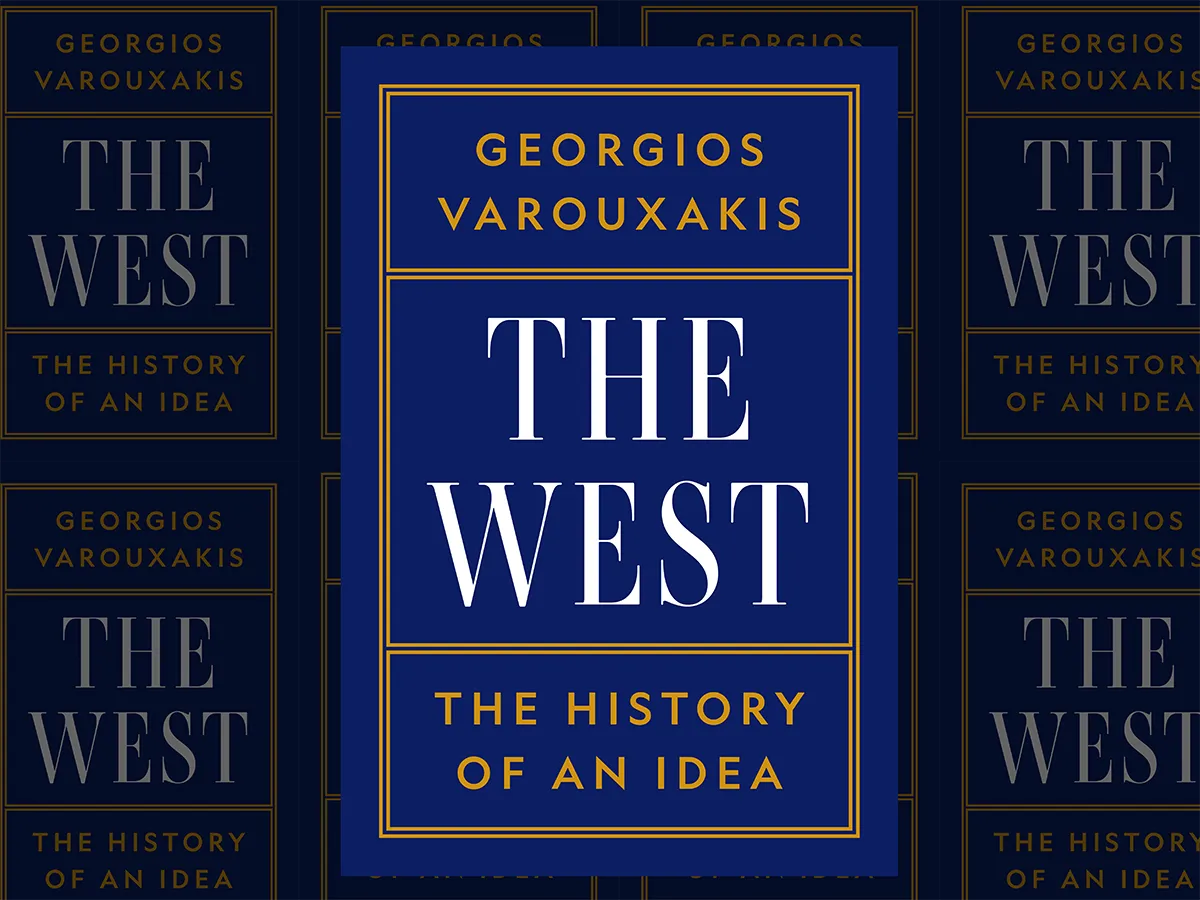
The West: The History of an Idea by Georgios Varouxakis
Registration REQUIRED by 4pm on January 20, 2027 in order to attend this event.
Please join the East Central European Center, the Harriman Institute, the Department of History, the Maison Française, and the Department of French for a book talk by Georgios Varouxakis, in conversation with Karuna Mantena, Clara Maier, Helena Rosenblatt, and Tamsin Shaw. The book talk, moderated by Małgorzata Mazurek, will take place at the Maison Française.
In The West: The History of an Idea (Princeton, 2025), Georgios Varouxakis challenges more or less everything readers may have thought about the idea of the West. The book will both surprise those who assumed that the West exists “from Plato and NATO,” and give second thoughts to those who took for granted that the West became politically meaningful during the Cold War. It meanwhile upsets the academic truisms that the concept of “the West” arose in the 1890s to justify high imperialism, that it emerged in juxtaposition to Asia or Islam, or that at its core are individualism and the Anglosphere. Varouxakis suggests a new way forward: it begins with the emergence of the “West” as part of a staunchly anti-imperialist program in the early nineteenth century, including efforts of the Polish thinkers and activists vis-à-vis Russia such as Adam Czartoryski and Czesław Miłosz; and ending with the momentous implications of the Ukraine war. The book highlights the open-endedness of the idea of “the West”.
The West: The History of an Idea has been reviewed in Financial Times, New York Review of Books, London Review of Books, Foreign Policy, Foreign Affairs, The Wire, The Spectator, Times Literary Supplement, and Literary Review, among others.
Biographies
Georgios Varouxakis is Professor of the History of Political Thought at Queen Mary University of London and Co-Director of the Centre for the Study of the History of Political Thought. Georgios’s most recent book is The West: The History of an Idea (Princeton, 2025). His earlier books include Liberty Abroad: J.S. Mill on International Relations (Cambridge, 2013), Victorian Political Thought on France and the French (Palgrave Macmillan, 2002), Mill on Nationality (Routledge, 2002), and Contemporary France: An Introduction to French Politics and Society (Arnold, 2003, co-authored). He has been awarded visiting research fellowships at Princeton University, at the Lichtenberg-Kolleg, University of Göttingen, and at the Institut für die Wissenschaften vom Menschen, Vienna.
Karuna Mantena is Professor of Political Science at Columbia University and co-director of the International Conference for the Study of Political Thought (CSPT). She specializes in political theory with research interests in the history of political thought, the theory and history of empire, South Asian intellectual history, and postcolonial democracy. She is the author of Alibis of Empire: Henry Maine and the Ends of Liberal Imperialism (Princeton, 2010) and articles on Gandhi’s political realism, the nonviolence of Martin Luther King, and the theory and practice of nonviolence in the 20th century. She is currently finishing a book tentatively titled Gandhi and the Politics of Nonviolence.
Clara Maier is a political theorist and historian of political thought at Columbia University. Her research addresses the problem of judicialisation and democracy in Europe with a specific focus on Germany and Spain and has published widely on constitutionalism. Her writing on militant democracy, the history of judicial power in modern Germany, Carl Schmitt, Hans Kelsen and the concept of the Rechtsstaat have appeared in The Historical Journal, Modern Intellectual History, History of Political Thought, Jurisprudence as well as Der Staat, Archiv für Rechts-und Sozialphilosophie and the Frankfurter Allgemeine Zeitung. She teaches on the theory of the Frankfurt School, German legal thought, as well as the political theory of Hannah Arendt.
Helena Rosenblatt is Distinguished Professor of History, Political Science, and French at the Graduate Center of the City University of New York. She is the author of Rousseau and Geneva from the First Discourse to the Social Contract, Liberal Values: Benjamin Constant and the Politics of Religion, and The Lost History of Liberalism: From Ancient Rome to the Twenty-First Century. Her current project, for which she was awarded a John Simon Guggenheim Fellowship, is an intellectual biography of Madame de Staël.
Tamsin Shaw is Associate Professor of European and Mediterranean Studies and Philosophy at New York University. She received both her B.A. and Ph.D. from Cambridge University. She was formerly an Assistant Professor of Political Theory in the Politics Department at Princeton University, where she held the Lawrence S. Rockefeller University Preceptorship. She has also previously been a Junior Research Fellow at King’s College, Cambridge, and a member of the School of Social Science at the Institute for Advanced Study, Princeton. She is the author of Nietzsche’s Political Skepticism (Princeton, 2007) and is a regular contributor to The New York Review of Books.
Małgorzata Mazurek is an Associate Professor in the History Department and the co-director of the East Central European Center at Columbia University. Her interests include the history of social sciences, international development, the social history of labor and consumption in twentieth-century Poland, and the global history of communism. She published Society in Waiting Lines: On Experiences of Shortages in Postwar Poland (Warsaw, 2010), which deals with the history of social inequalities under state socialism. Her book A Place for All to Prosper: How Development Economics Emerged in Twentieth-Century Poland is forthcoming with the Cornell University Press in January 2027.
Event Details & Important Information
This event is free and open to the public, but please note that registration does not guarantee a seat. We intentionally overbook our events, and seating is first come, first served. We recommend arriving early.
Important: Campus Access Requirements
Columbia’s campus is currently open only to Columbia-affiliated guests (with a valid CUID).
If you do not have a Columbia ID, you will need a QR code to enter campus.
Columbia Public Safety will only issue one QR code per email address. If two or more names are registered on eventbrite using the same e-mail address, only one of them will receive a unique QR code. Please use a different personal e-mail address for each guest.
To receive a QR code:
- You must register on Eventbrite at least 48 hours in advance
- We will submit your name and email to Public Safety
- You will receive an email from [email protected] with your unique QR code
Please check your spam/junk folder if you don’t see the email, and bring a valid photo ID with you to present at campus entry points.