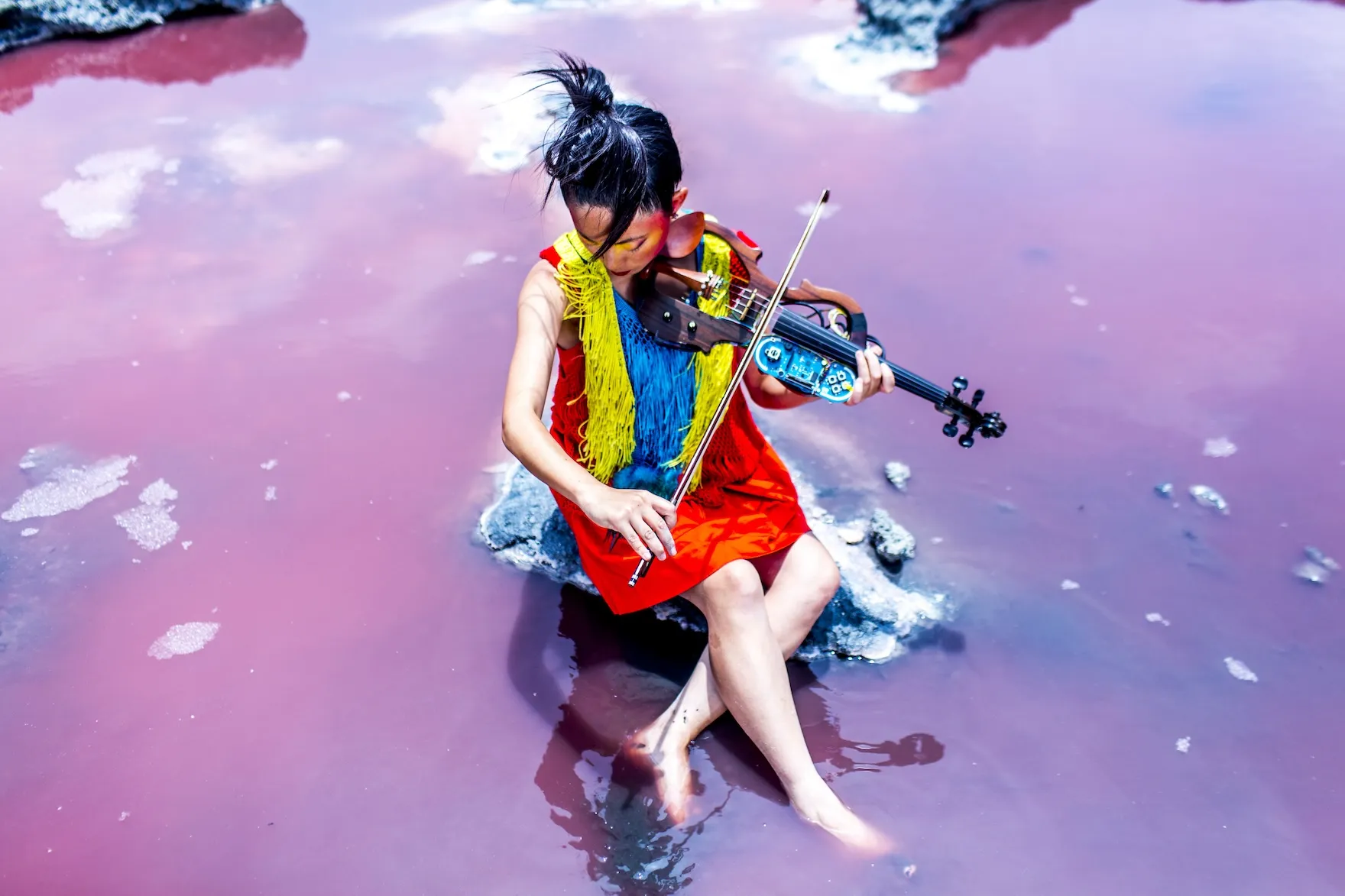
In this recital, talk and conversation, composer Pauchi Sasaki will present her current work, performed by violinist Jennifer Curtis, to be followed by a conversation with composer and Francis Goelet Professor of Music, Zosha di Castri. She will explore the idea of the extinction and mutation of human emotions and discuss how the disruption of the new technologies is deeply changing our perception of time, feelings and emotions. Can music itself become an act of resistance—a space in time where we can preserve the experience of long emotions, a reliquary of human abstractions?
Composer Pauchi Sasaki is Professor of Music at the Department of Performing Arts at Pontificia Universidad Católica del Perú. Her interdisciplinary approach integrates musical composition with the creation of multimedia performances, the application of new technologies, and the development of self-designed instruments such as the Speaker Dress. In 2016, she became Philip Glass’ protégé as part of The Rolex Mentor and Protégé Arts Initiative. She was a 2022-23 Fellow at the Columbia Institute for Ideas and Imagination, and this year was selected at the Cannes Film Festival's Spot the Composer program. Her numerous commissions and film scores have been presented at international venues including the Tokyo Experimental Festival, Venice Biennale, Carnegie Hall, Lincoln Center, and the John F. Kennedy Center for the Performing Arts.
Violinist Jennifer Curtis is an improviser and composer, and teaches violin at Duke University. She has won the Milka-astral grand prize for violin, Juilliard concerto competitions and competed in Austria at the international Brahms competition. She has appeared as a soloist with the Simon Bolivar Orchestra in Venezuela, performed her own mini concerto with the Knights Chamber Orchestra, and collaborated with composer John Adams at the Library of Congress. Jennifer was a member of the International Contemporary Ensemble (ICE) for 14 years. As a composer, she has been in residence at Cornell, composed in India for classical dance and been presented at Spoleto Festival Italy and Verbier. She performs regularly with the North Carolina Symphony and plays on a 1777 Vincenzo Panormo violin.
Composer Zosha Di Castri is Francis Goelet Associate Professor of Music at Columbia University. She was a recipient of the 2023 American Academy of Arts and Letters Goddard Lieberson Fellowship, and the 2021 Guggenheim Fellowship. She was an inaugural 2018-19 Fellow at the Columbia Institute for Ideas and Imagination, where she wrote Long is ––Short is the Memory, whose world premiere opened the First Night of the BBC Proms in the Royal Albert Hall in 2019. Highlights this season include the world premiere and European tour of Invisible House for orchestra, written to open the New York Philharmonic’s season and co-commissioned by the LA Philharmonic, both conducted by Gustavo Dudamel.
This event is co-sponsored by the Institute for Ideas and Imagination, Department of Music, and Maison Française. We acknowledge with gratitude the additional assistance of the Ministry of Culture of Peru and Ibermúsicas.
Event Details & Important Information
This event is free and open to the public, but please note that registration does not guarantee a seat. We intentionally overbook our events, and seating is first come, first served. We recommend arriving early.
Important: Campus Access Requirements
Columbia’s campus is currently open only to Columbia-affiliated guests (with a valid CUID).
If you do not have a Columbia ID, you will need a QR code to enter campus.
Columbia Public Safety will only issue one QR code per email address. If two or more names are registered on eventbrite using the same e-mail address, only one of them will receive a unique QR code. Please use a different personal e-mail address for each guest.
To receive a QR code:
- You must register on Eventbrite at least 48 hours in advance
- We will submit your name and email to Public Safety
- You will receive an email from [email protected] with your unique QR code
Please check your spam/junk folder if you don’t see the email, and bring a valid photo ID with you to present at campus entry points.