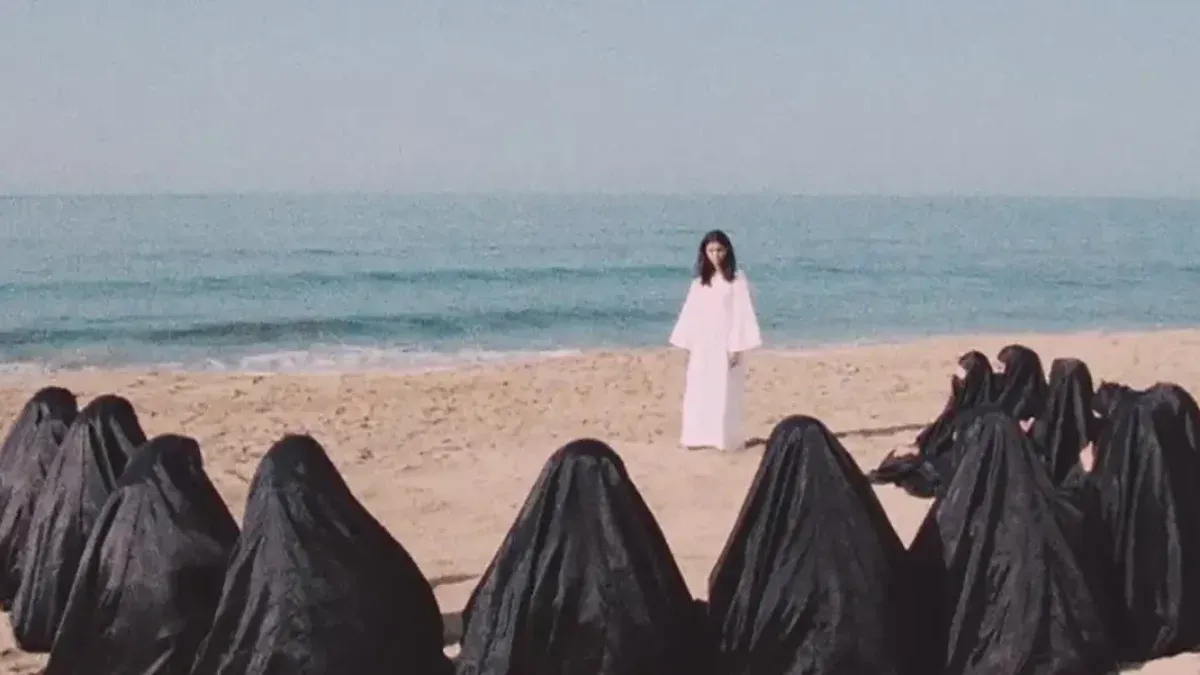
Heiny Srour, 1984, 90 min. In Arabic with English subtitles
Screening followed by a Q&A with the director Heiny Srour and Madeleine Dobie
Introduction by Renate Mattar
Watch the recording of this event on our youtube channel here
“This film is based on actual events which are part of the collective memory of the Lebanese and Palestinian people.” So begins Leila and the Wolves, Lebanese filmmaker Heiny Srour’s only narrative feature—a bold, lyrical homage to the often-erased legacy of Arab women in the liberation struggle - newly restored in 2024. At its center is Leila (Nabila Zeitouni), a Lebanese woman living in London, who uncovers the overlooked contributions of women—fighters, nurturers, strategists—to the broader revolutionary movement. Drawing on the Arab heritage of oral tradition and mosaic pattern, Leila and the Wolves blends reenactment, archival footage, folklore in a visually and narratively hybrid cinematic essay and feminist counter narrative. It was banned in the Arab World for 45 years—and still is in many Arab countries.
The film has been rarely shown and was restored in 2024.
Watch the trailer here
Heiny Srour is a Lebanese film director. She is best known for being the first female Arab filmmaker to have a film (The Hour of Liberation Has Arrived) chosen for the Cannes Film Festival, in 1974. Despite the film’s accolades and success at Cannes, The Hour of Liberation Has Arrived was banned in most of the Arab world for its socialist and feminist politics. Srour has advocated for women's rights through her films, her writing, and by funding other filmmakers. Her first feature film, Leila and the Wolves, also reflects her feminist politics and socialist politics.
Madeleine Dobie is Professor of French and Comparative Literature at Columbia. Her areas of expertise include Francophone/postcolonial literature, colonial history, and 18th-century culture, and she has a particular interest in Algerian history and culture. She is currently working on a book about testimony given long after a violent or traumatic event, including belated accounts of the Algerian Revolution written by combatants and militants. A second current book project is about literature, cinema and other forms of artistic expression in contemporary Algeria.
Renate Mattar is a third year Ph.D. student in French and Comparative Literature at Columbia University. Her interests include memory studies, post-colonial studies, Gender studies.
This screening is part of Columbia Maison Française CENSORED FILM SERIES - FALL 2025.
Event Details & Important Information
This event is free and open to the public, but please note that registration does not guarantee a seat. We intentionally overbook our events, and seating is first come, first served. We recommend arriving early.
Important: Campus Access Requirements
Columbia’s campus is currently open only to Columbia-affiliated guests (with a valid CUID).
If you do not have a Columbia ID, you will need a QR code to enter campus.
To receive a QR code:
- You must register on Eventbrite at least 48 hours in advance
- We will submit your name and email to Public Safety
- You will receive an email from [email protected] with your unique QR code
Please check your spam/junk folder if you don’t see the email, and bring a valid photo ID with you to present at campus entry points.