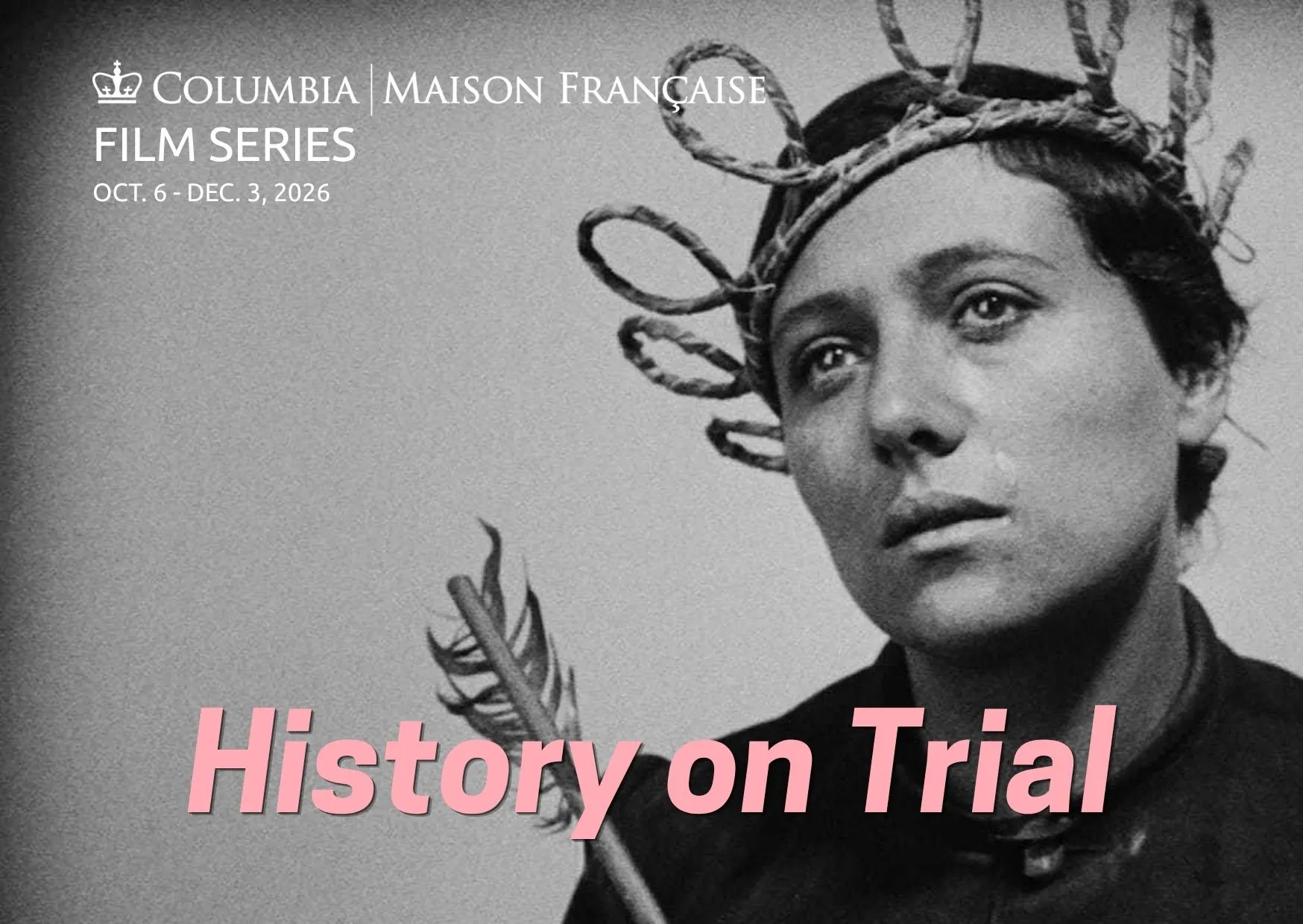
Tuesday, October 6-Thursday, December 3, 2026
History on Trial
Maison Française Film Series
Curated by Shanny Peer with contributions by Emmanuel Kattan and Jane Gaines.
Additional support for the series is provided by the School of the Arts Film & Media Division, Alliance Program, Society of Fellows and Heyman Center for the Humanities, and Dean of Humanities. Additional sponsors of Filmmakers for the Prosecution are Columbia University Press, the Department of History, ISERP, and the Department of Germanic Studies.
Screenings are followed by discussions with invited scholars.
All films are subtitled in English.
Free and open to all. RSVP required.
Series Description
Trials occupy a unique place in the historical record. By compelling witnesses, defendants, accusers, and judges to account for themselves, they generate unusually rich archives of testimony, evidence, and argument. For historians, such records often provide rare access to worlds that would otherwise remain inaccessible. For filmmakers, trials offer a powerful dramatic form through which larger questions of truth, memory, responsibility, and justice can be explored.
The films in this series examine the relationship between trials and history in a variety of ways. Some draw directly upon judicial archives to reconstruct the lived experience of the past. Others explore how legal proceedings become sites of historical memory, political accountability, and cultural interpretation. Whether based on documentary records or fictional proceedings, each film uses the courtroom as a space in which individuals are called upon to explain themselves and societies reveal their deepest assumptions, values, and conflicts.
The Passion of Joan of Arc (October 8) draws upon the surviving transcripts of Joan's 1431 trial, one of the most remarkable documentary records of the Middle Ages. Through Joan's testimony and the probing questions of her inquisitors, the film reveals not only an extraordinary individual but also the religious beliefs, legal reasoning, and gender assumptions of late medieval Europe.
Similarly, The Return of Martin Guerre (October 29) is rooted in the documentary record of a celebrated sixteenth-century French trial concerning identity, deception, and marriage. The case became the basis for historian Natalie Zemon Davis's influential reconstruction of village life, demonstrating how legal archives can provide rare insight into the social relationships, values, and everyday experiences of ordinary people whose voices are seldom preserved in the historical record.
Filmmakers for the Prosecution (October 18) shifts attention from the archive as historical source to the archive as legal evidence. Revisiting the Nuremberg Trials, the film recounts how documentary footage shot by the Nazi regime itself was recovered, assembled, and presented by prosecutors to establish the reality of crimes against humanity. Here, moving images become both historical record and judicial proof, raising profound questions about evidence, memory, and the representation of atrocity. On October 19, Sylvie Lindeperg will deepen this discussion in a conversation about her book, Staging Nuremberg: How the United States and the Soviet Union Fought over the Portrayal of Nazi Crimes.
Bamako (October 6) employs a fictional trial to place history itself in the dock. Set in the Malian capital, the film stages a public prosecution of the World Bank and International Monetary Fund while everyday life unfolds around the proceedings. Through this imagined courtroom, the film interrogates the legacies of colonialism, global inequality, and economic dependency, transforming the trial into a forum for historical reckoning and debate.
Saint Omer (December 3) brings these questions into the present. Inspired by a real contemporary French trial, the film follows a novelist observing the prosecution of a young Senegalese woman accused of killing her infant daughter. As testimony unfolds, the courtroom becomes a space in which questions of race, migration, motherhood, class, and postcolonial identity are examined. Like the other historical trials in the series, the proceedings reveal far more than the fate of a single defendant. They expose the social and cultural tensions of contemporary France while demonstrating how trials create records through which future generations may seek to understand the present.
Taken together, these films suggest that trials are never merely legal events. They are moments when private lives, public values, and historical forces become visible at the same time. Whether preserved in archival records or imagined as acts of political critique, the trials depicted in these films offer powerful ways of understanding the worlds that produced them. In doing so, they reveal the courtroom not only as a place where judgments are rendered, but also as a space where history itself is recorded, contested, and remembered.
Featured Films
Tuesday, October 6, 6:30-9:00 PM
Bamako
Abderrahmane Sissako, 2007, 115 min.
In French and Bambara with English subtitles
Screening followed by a discussion with Souleymane Bachir Diagne and Gregory Mann
Thursday, October 8, 6:30-9:00 PM
The Passion of Joan of Arc (La Passion de Jeanne d’Arc)
Carl Theodor Dreyer, 1928, 110 min.
Silent film screening with live music by Steve Sterner, following by discussion with Christia Mercer and Nico Baumbach
Sunday, October 18, 6:30-8:00 PM
Filmmakers for the Prosecution
Jean-Christophe Klotz, France, 2022, 60 min.
Screening at the Lenfest Center for the Arts
Monday, October 19, 6:30-7:30 PM
Staging Nuremberg: How the United States and the Soviet Union Fought Over the Portrayal of Nazi Crimes
Sylvie Lindeperg and Annette Insdorf in conversation (at Columbia Maison Française)
Thursday, October 29, 6:30-9:00 PM
The Return of Martin Guerre (Le Retour de Martin Guerre)
Daniel Vigne, 1982, 122 min.
Screening followed by discussion with Shanny Peer and Jeffrey Freedman
Thursday, December 3, 6:30-9:00 PM
Saint Omer
Alice Diop, 2022, 122 min.
Screening followed by discussion with Aubrey Gabel and Zoë L. Henry