Habiba Boumlik and Lucy McNair in conversation with Madeleine Dobie
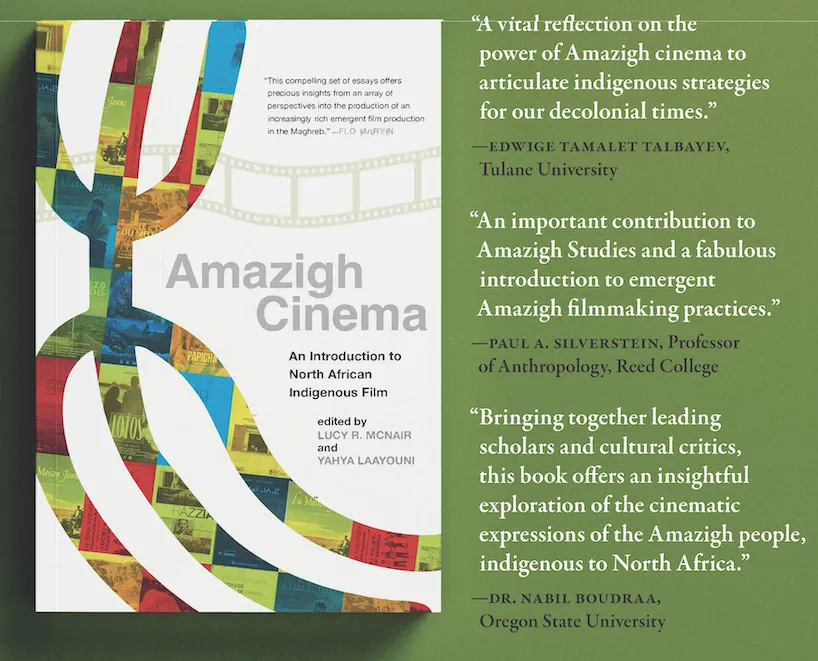
Lucy McNair and Habiba Boumlik discuss their book, An Introduction to North African Indigenous Film (2025), with a screening of Taazrit (Arinas Kaouther Dernouni, 2024, 35 min.).
Amazigh Cinema: Introduction to North African Indigenous Film (University of Regina Press/NYU Press, 2025), co-edited by Lucy McNair and Yahya Laayouni, is a collection of essays by an international group of experts on North African Indigenous expression and media, which offers the first English-language analysis of Amazigh cinema for North American and global readers, taking note of a growing archive of under-examined Amazigh-related films. As co-editors, McNair and Laayouni provide a critical introduction to this archive’s historical, cultural, and linguistic contexts across the space of the Tamazgha and diasporic communities. Some chapters trace broad links between oral performance, amateur video, and feature films, and offer theoretical frameworks. The book contrasts Amazigh production with other national and global cinemas and evaluates the reception of what contributors alternately call “Amazigh-Speaking Cinema” or “Amazigh cinematographic space.” Examining how cinematic art plays a role in preserving Amazigh language and shaping Amazigh identity or Amazighity, including gender identity, the essay collection also shows how these films give witness to a long history of repression and exclusion as well as creative resiliency.
Taazrit, (directed by Arinas Kaouther Dernouni, 2024, 35 min., in Arabic, Chaoui, and French, with English subtitles) follows the daily life of Habiba, a Chaoui woman from Ghassira, a semi-desert village in the Aurès Mountains of eastern Algeria. Far from neo-orientalist stereotypes, her relationship to the land resonates as an expression of collective memory — the memory of generations of women who shaped their lives beyond official narratives and modern conceptions that reduce belonging to an act of ownership. Habiba navigates between her attachment to traditions that carry the stories of her ancestors and her desire to redefine her identity beyond imposed categories. Through her journey, she raises profound questions about freedom, belonging, and self-determination, revealing how a woman can reclaim her body, her land, and her life in the face of social constraints. Beneath her apparent lightness lies a quiet yet unwavering form of resistance, one that redefines her connection to territory, history, and herself.
Biographies
Habiba Boumlik is Professor at CUNY LaGuardia Community College and a scholar of Amazigh cinema. She teaches French and Arabic languages and literatures, as well as Middle Eastern and North African cinema. She founded the New York Forum of Amazigh Film (NYFAF) to bring visibility to the Amazigh communities and cultures in North Africa and the diaspora through cinema, and to advocate for Amazigh cinematic production and recognition. Her research and curatorial work explore themes of diasporic Amazigh film, transnational identities, and the role of film festivals in preserving cultural heritage. Her recent publications include: "Global Trajectories, Localized Stories: Amazigh Filmmaking through the Eyes of Selected Filmmakers" in Amazigh Cinema: An Introduction to North African Indigenous Film (2025); "Journeys of Discovery: The Case of the New York Forum of Amazigh Film" in African Film Festivals and Transnational Flows of Living Cultural Heritage (2025); and "Indigeneity and Identity Transmission: Amazigh Cultural Expression through Film" in The Bloomsbury Handbook of Muslims and Popular Culture (2023).
Lucy R. McNair is a translator and Professor of English at LaGuardia Community College, City University of New York. Her research focuses on North African Francophone and Amazigh literature and film, exploring themes of traumatic memory, Indigeneity and Amazighity, and the female Indigenous gaze in cinema. In 2015, she became a co-curator of the New York Forum of Amazigh Film, which brings community college students together with North African filmmakers, musicians, artists, and scholars to discover contemporary Amazigh life and culture. This work resulted in a groundbreaking edited collection, Amazigh Cinema: An Introduction to North African Indigenous Film (University of Regina Press/NYU Press, 2025), and the article "Journeys of Discovery: The Case of the New York Forum of Amazigh Film" in African Film Festivals and Transnational Flows of Living Cultural Heritage, ed. Sheila Petty (Palgrave, 2025).
Event Details & Important Information
This event is free and open to the public, but please note that registration does not guarantee a seat. We intentionally overbook our events, and seating is first come, first served. We recommend arriving early.
Important: Campus Access Requirements
Columbia’s campus is currently open only to Columbia-affiliated guests (with a valid CUID).
If you do not have a Columbia ID, you will need a QR code to enter campus.
Columbia Public Safety will only issue one QR code per email address. If two or more names are registered on eventbrite using the same e-mail address, only one of them will receive a unique QR code. Please use a different personal e-mail address for each guest.
To receive a QR code:
- You must register on Eventbrite at least 48 hours in advance
- We will submit your name and email to Public Safety
- You will receive an email from [email protected] with your unique QR code
Please check your spam/junk folder if you don’t see the email, and bring a valid photo ID with you to present at campus entry points.